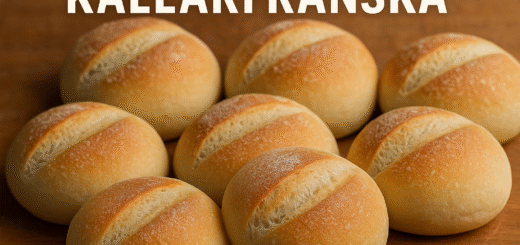
Greek Village Bread
Greek Village Bread recipie
(3 loaves, ~570 g each)
Do you want real Greek village bread? No mess, no rolling pin, just pure rustic flavor. A crispy, aromatic crust and a beautiful open crumb – the kind of bread that tastes like home.
For this bread, you’ll need:
Ingredients:
1000 g wheat flour (about 12% protein),
680 g hot water (50°C),
14 g dry yeast,
11 g salt.
Total dough weight ≈ 1705 g → 3 portions of ~570 g.
1. Mixing (bulk fermentation)
- Combine the flour, yeast, and salt in a large bowl.
- Gradually add the hot water (about 50°C), mixing with a tablespoon.
- Stir until the dough becomes uniform and sticky.
- Cover and let it rest for 40–60 minutes — it should double in size and become more elastic and easier to handle.
2. Dividing and Resting
- Turn the dough out onto a lightly floured surface.
- Divide it into 3 pieces of ~570 g each
- Slightly round each piece.
- Cover and let them rest for 10 minutes.
3. Folding (strengthening the dough)
Method “third – to the center”
Step 1. Shape into a rectangle
Gently flatten the dough with your hands, stretching it into a rectangle.
Don’t press hard – just even out the surface.
Step 2. Top third → down, to the center
Lift the top third (about 1/3 of the height)
and fold it down toward the center, so the edge lands around the middle.
Step 3. Bottom third → up, covering the fold
Lift the bottom third
and fold it up, covering the previous fold — like closing a letter.
Step 4. Turn 90° and repeat (for structure)
Perform 1–2 more folds after turning the dough 90°,
until the dough becomes smooth, tightened, and elastic.
Total — about 6 folds performed over each piece of dough.
4. Final Shaping
After folding:
- Lightly flatten the dough.
- Fold the top toward the center.
- Fold the bottom toward the center.
- Bring the sides slightly inward.
- Pull the dough tight to create surface tension and shape a firm ball or oval.
- Place seam-side down in a basket/bowl.
5. Proofing
Let the dough rise again for 45–60 minutes,
until it increases by about 70–80%. At this time you may start preheating (from chapter 6)
6. Baking
Preheating
Place an empty Dutch oven into the oven and heat it to 250°C.
Baking
- Carefully transfer the dough into the hot Dutch oven (preferably on parchment).
- Make 1–3 slashes or how to say scores
- Bake:
- 15 minutes with the lid on at 250°C,
- 18–22 minutes without the lid at 220°C.
(Alternative: on a baking stone or tray — 250°C for 10 minutes with steam,
then 220°C for 20–25 minutes until golden.)
Ostaljnije dva otpravljajte v holodiljnik dla medlennoj fermentaciji i vipekajte pozzhe